
REVIEW – The Tentsile Safari Stingray Tree Tent – Sleep suspended above the ground sounds like the sort of outdoor product that could easily be more stunt than shelter. After all, a three-person tent that hangs between trees has plenty of ways to be awkward, fussy, or simply too strange for regular camping. After using it, though, I came away impressed. It is not just a hammock with extra marketing around it; it is a serious, well-built suspended tent that changes where and how you can sleep outdoors.
The catch is the price. At $1,159, the Safari Stingray sits firmly in premium-tent territory. That makes it a considered purchase, not an impulse upgrade. But it also does something most expensive tents cannot do: it gets you off uneven, wet, rocky, or root-covered ground and gives you a floating base camp with room for three.
The Basics
The Safari Stingray is a three-point suspended tent designed to anchor between three trees. Instead of pitching on the ground, you tension the body with heavy-duty ratchets and straps, then add the poles and rainfly much like you would with a more conventional shelter. The interior is sized for up to three adults, and the mesh canopy keeps the space airy while helping keep bugs out.

The box that arrived at my door was plain, heavy, and visibly travel-worn. Nothing inside seemed worse for the journey, but this is definitely not a featherweight backpacking tent. It is more of a car-camping, base-camp, or short-haul adventure shelter.
What You Get
- Safari Stingray 3-Person Tree Tent
- Rainfly
- Tent Bag
- 2 x Anodized aluminum alloy poles
- 3 x Understorage Nets
- 3 x Heavy-duty ratchet buckles
- 3 x Polyester straps 19ft (6m)
- 3 x Low-impact yellow screw pegs
- 3 x WaterGates
- 3 x Bungee Cords
- 3 x Tree Wraps

By the Numbers
- Capacity: 880lbs (400kg)
- Seasons: 4-Season
- Weight: 33.1lbs (15kg)
- Packed Size: 25.5 x 11.8 x 11.8in (65 x 35 x 35cm)
- Head Height: 4ft (1.2m)
- Floor Area: 78sqft (7.25sqm)
- Floor Dimensions: 13.5 x 13.5 x 13.5ft (4.1 x 4.1 x 4.1m)
- Covered Porch Area: 150sqft (14sqm)
- Rainfly Fabric: 70D, PVC coated Polyester (8,000HH)
- Floor Fabric: 600D Dacron, PU coated
- Insect Mesh: No-See-Um Insect Mesh 115g/sqm
- Ratchets: 2.5-Ton Rated
- Straps: 35mm x 6m Polyester
- Poles: 11mm Anodized Aluminium
- Doors: 3 & center hatch
- Recommended setup height: 4ft (1.2m)
- Minimum tree diameter: 16in (40cm)
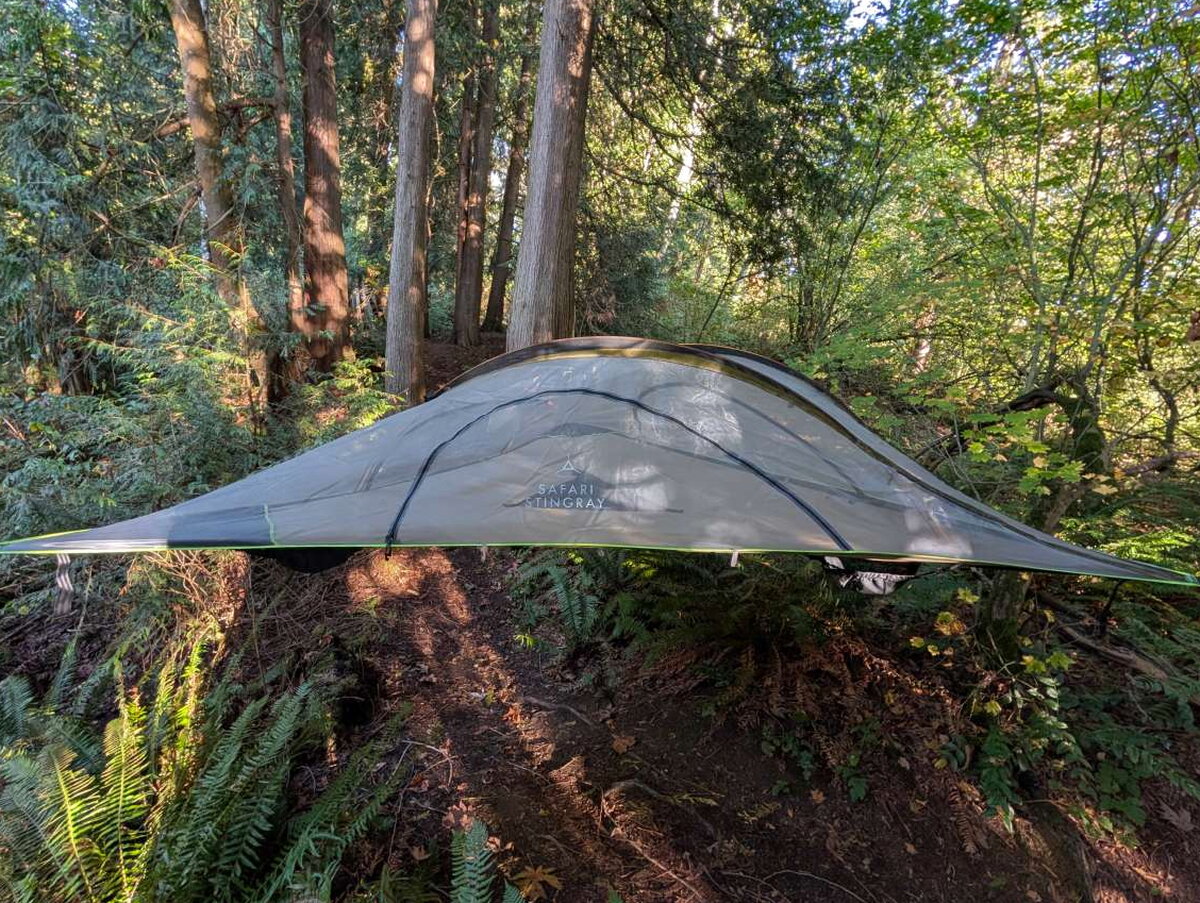
Design & Build
The Safari Stingray works because its floor is more like a suspended platform than a soft hammock. The 600D Dacron fabric is reinforced by seatbelt-style webbing, and that webbing does two important jobs: it distributes the load across the structure and naturally divides the floor into individual sleeping zones. Before climbing in, I expected the whole thing to sag or twist. In practice, it felt far more controlled than I expected.

The three-anchor layout is the heart of the design. Once the sides are tensioned, the floor has enough give to be comfortable but not so much that everyone rolls into the middle.

Ventilation is handled by the large No-See-Um mesh canopy. The mesh is tight enough to keep insects out, yet the tent never felt stuffy during testing.

Inside, three hanging storage nets give each occupant a place for phones, keys, headlamps, and other small items that would otherwise migrate across the floor.

There are also three larger storage nets under the tent. They are especially useful because shoes and packs can stay out of the sleeping area without being left directly on wet or dirty ground.

The included ratchets are serious hardware. Each one is rated to 2.5 tons, and they are what let the tent be tensioned firmly enough to behave like a suspended platform.

Tentsile also includes three WaterGates. These small rubber pieces clip near the ratchets and help stop rainwater from tracking along the straps and finding its way under the rainfly.

The rainfly is made from 70D polyester with an 8000HH waterproof rating. For context, many tents are considered waterproof around the 3000HH mark, so the fly is built for real weather. It also extends beyond the tent body, creating a protected area below for gear or a sheltered hangout spot.

The Tree Wraps are a thoughtful inclusion. They sit between the straps and the tree trunks to reduce damage to bark while the tent is under load.
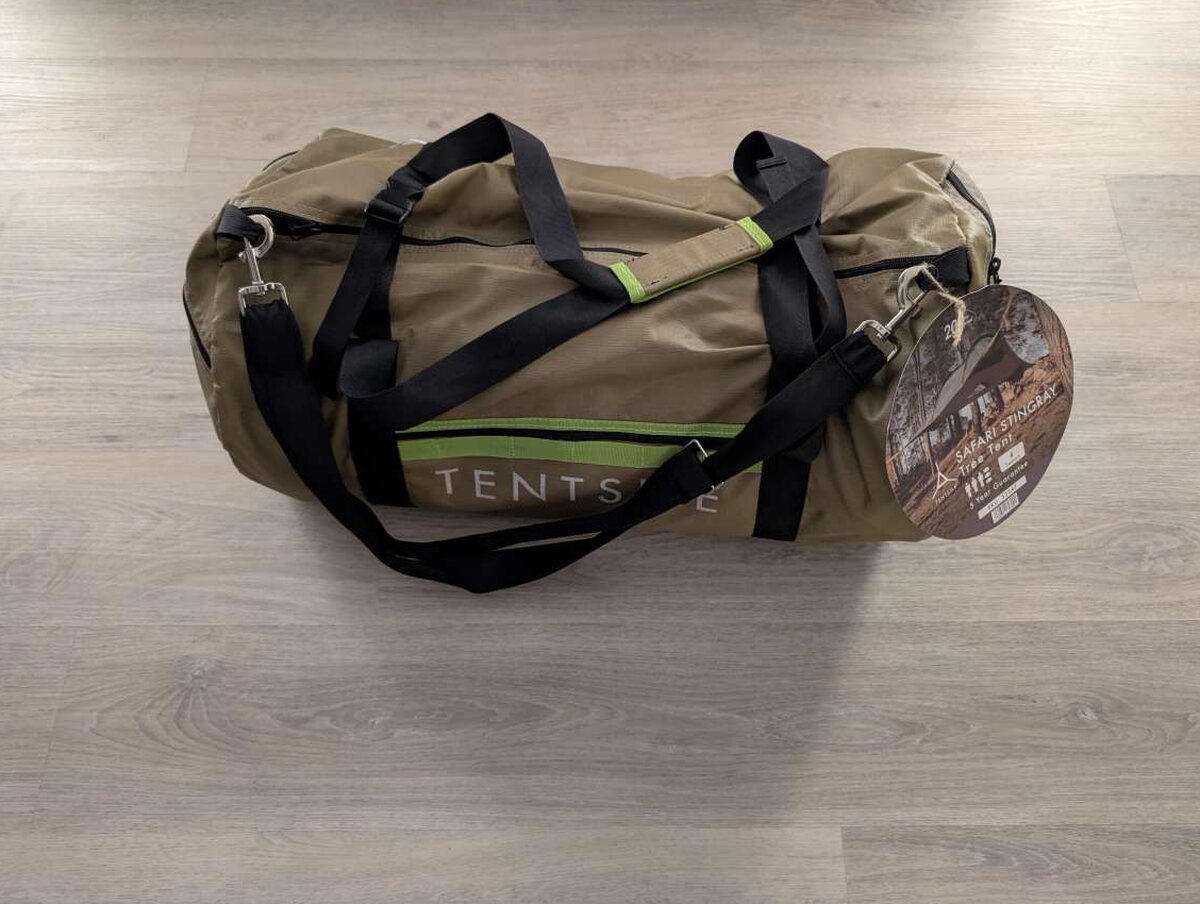
Everything packs into a large ripstop storage bag. I appreciated that the bag is forgivingly oversized; you do not have to achieve a factory-perfect roll to get the tent put away.

Getting Started
Setup is straightforward once you understand the sequence, but site selection matters more than it does with a normal tent. You need three trees roughly 10 to 15 feet apart, positioned at usable angles and large enough to support the load. Tentsile recommends trees at least 16 inches in diameter and a setup height around 4 feet. Finding that perfect triangle took us longer than the actual assembly.

Once you have the site, wrap the straps around the trees at a comfortable height. The goal is high enough to clear the ground and use the center hatch, but low enough that getting in and out does not become an athletic event.

Next, the ratchet loops feed through the metal rings at the tent corners. This part is simple, but it is worth taking a moment to keep everything flat and untwisted.

Flat strap routing matters. If the loops bind or cross awkwardly around the tree, tensioning becomes harder and the load is not as cleanly distributed.

After connecting the ratchets and threading the straps, pull out the slack by hand, then start tightening with the ratchets. This is where the Stingray begins to lift and take shape.
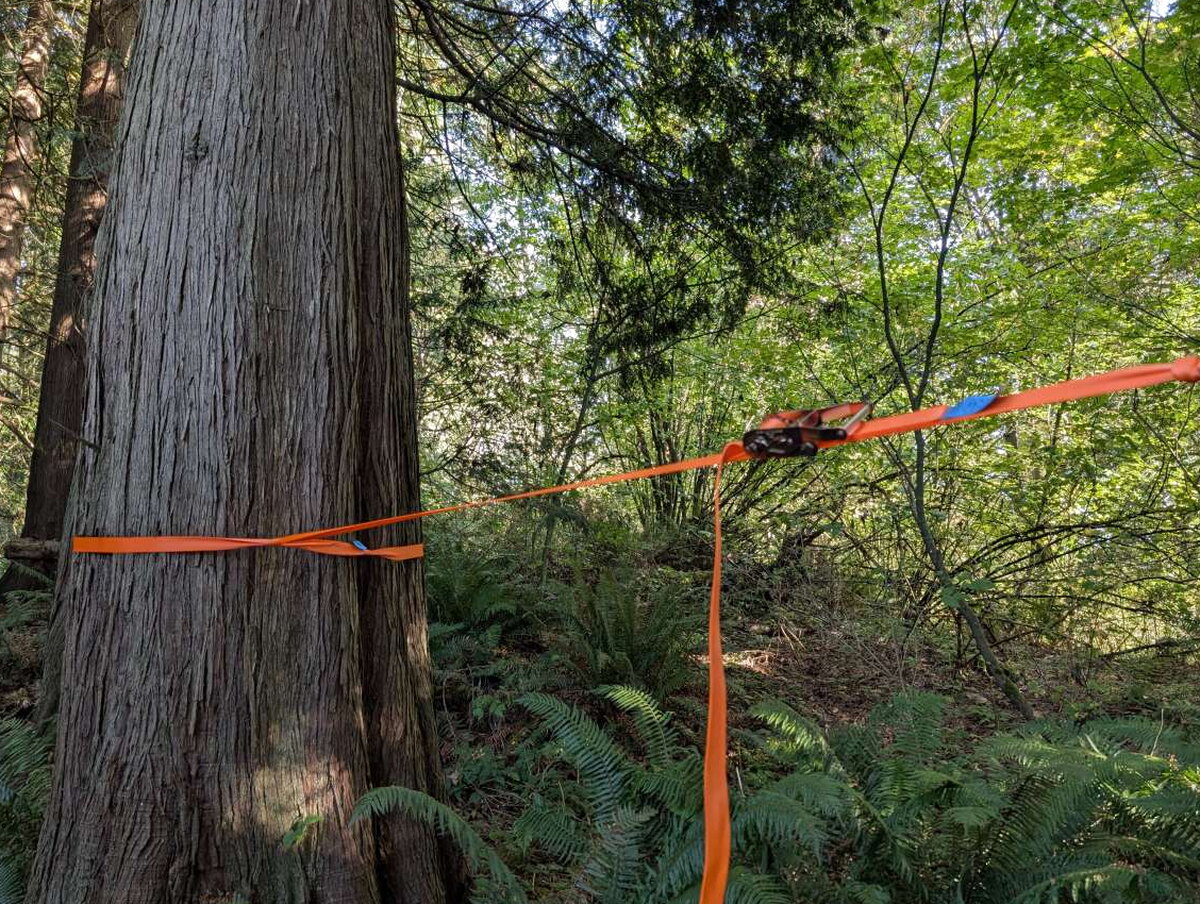
When the tent reaches the correct tension, the ratchets lock down so the structure stays secure. The process is not complicated, but it rewards patience and even tightening.

Our first candidate site looked promising, but one side of the tree triangle was too short. The tent would hang, but it was not the clean, balanced setup we wanted.

The second spot had better distances, but the angles were wrong. That made it difficult to get the same tension across all three sides.

The third location finally gave us the spacing and geometry we needed. Once you have the right trees, the rest of the setup feels much more predictable.

We checked the level, tightened the straps carefully, and stopped when the floor felt firm without feeling overstressed.

The two aluminum poles then slide through loops across the tent to raise the roof and create usable headroom.

The poles stay put through a combination of bow tension and plastic end caps. It is a simple solution that works well once the tent body is properly tensioned.

With the structure up, the remaining question was how easy it would be to use. A suspended tent can look amazing from the outside, but it has to be practical once people start climbing in.
Living With It
The easiest way in is through the center hatch. The reinforced floor edge gives you something substantial to lean against, and the hatch can be opened from outside before you climb up.

My younger helper made entry look effortless. He leaned into the opening, shifted his weight, and pulled himself inside without much drama.

I expected the tent to dip noticeably once someone climbed aboard, but it barely moved. That was the first real moment when the engineering clicked for me.
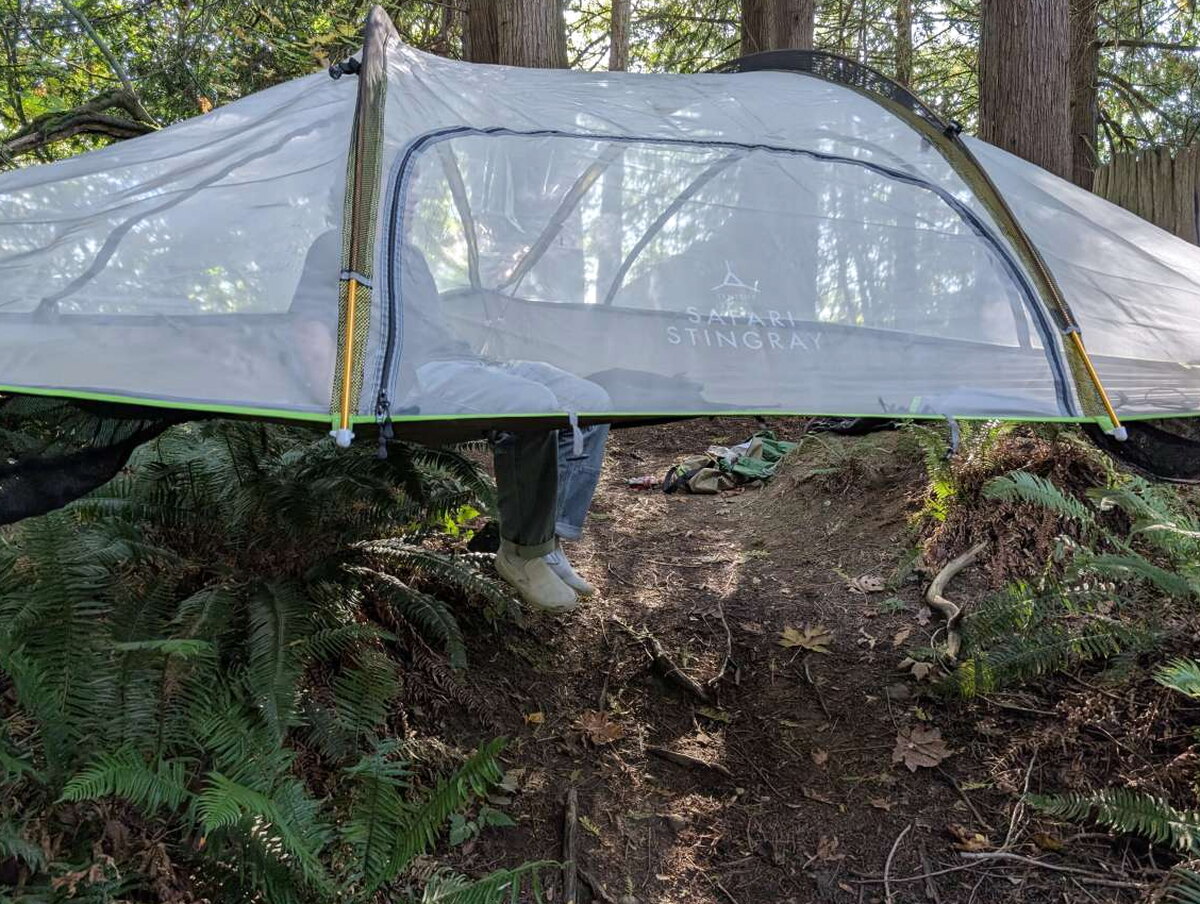
Shoes are the awkward part. If the ground is muddy, you have to decide how to keep that mess out of the sleeping space while still getting yourself inside.
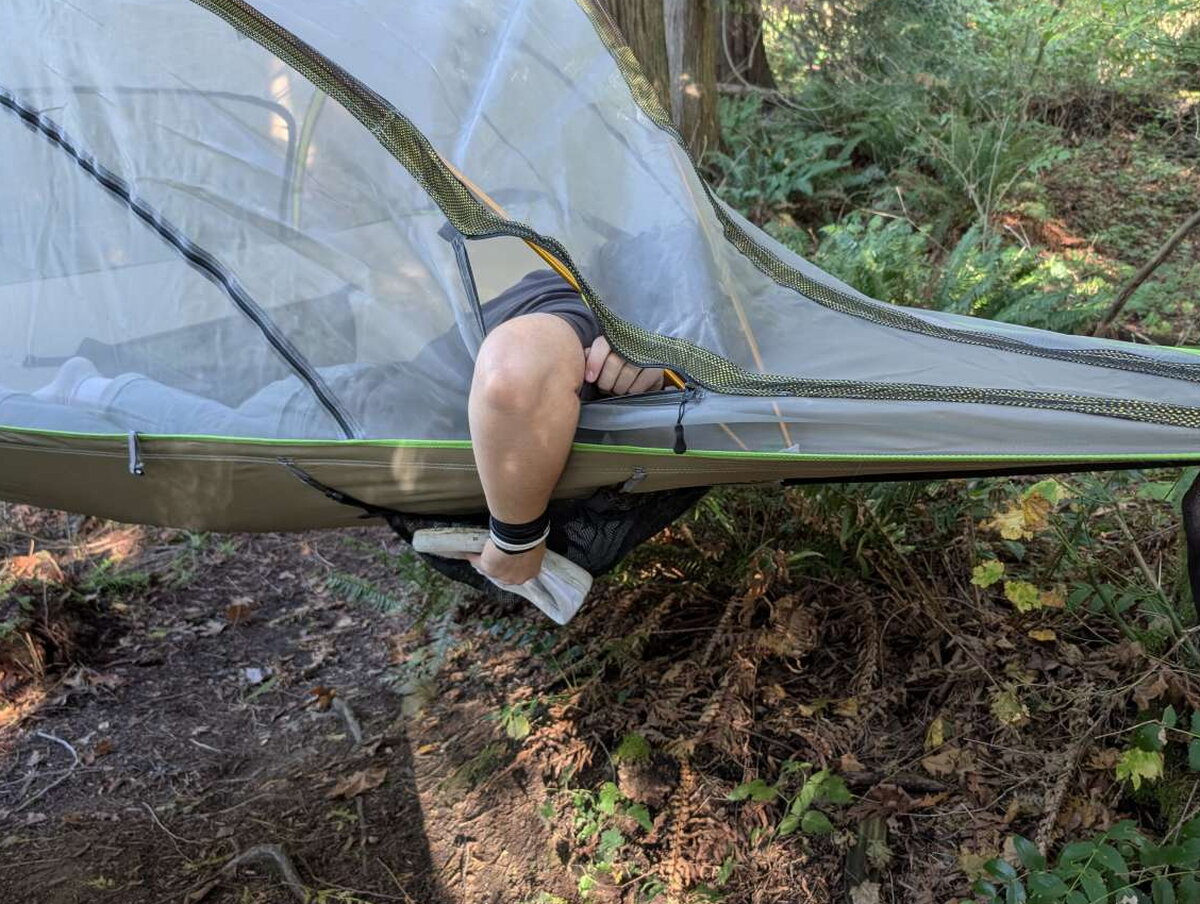
The underside nets solved most of that problem. With a stretch from inside, we could tuck shoes and other dirty items below the floor but still keep them protected and reachable.

My own entrance was less graceful, but I got in without incident. The hatch is usable; it just takes a little coordination if you are not as limber as your camping assistant.

Once inside, the Safari Stingray feels much bigger than it looks from the ground. The triangular layout gives each person a defined area, and the suspended floor feels more stable than hammock campers might expect.

The webbing layout helps keep occupants from sliding together. With two of us inside, there was no meaningful lean, sag, or sense that one person was pulling the floor out of shape for the other.

The interior storage pockets were easy to reposition where we wanted them. That flexibility matters because in a tent like this, loose small items can otherwise disappear into corners or under bedding.

For two people, the tent felt downright luxurious. We could stretch out, shift around, and keep extra gear nearby without crowding each other.

The best part is the view. With mesh all around and the floor lifted above the ground, the Safari Stingray gives you a panoramic, tucked-into-the-trees feeling that a normal tent cannot match. I would love to spend a clear night in it with the stars overhead.

By the end of testing, the Safari Stingray had moved from curiosity to something I genuinely wanted to take on a longer trip.
The Good
- Excellent build quality and clever suspended-floor engineering
- Roomy, comfortable interior for two or three campers
- Gets you above wet, uneven, rocky, or root-covered ground
- Great airflow, visibility, and storage options
The Not So Good
- Very expensive
- Finding three properly spaced, properly sized trees can take time
- Entry and exit require more coordination than a ground tent
- Too heavy for most backpacking use
Quick Questions
Q: How many trees does the Tentsile Safari Stingray need?
A: Three, spaced roughly 10-15 feet apart, each at least 16 inches in diameter.
Q: How much weight can it hold?
A: 880 lbs (400 kg).
Q: Is it good for backpacking?
A: Not really, it weighs about 33 lbs and is described as too heavy for most backpacking use, better suited to car camping or a base camp.
Q: What keeps rain from running down the anchor straps?
A: Included WaterGates, small rubber pieces that clip near the ratchets to divert rainwater before it tracks toward the tent body.
The Verdict
The Tentsile Safari Stingray Tree Tent is not the practical choice for every camper, and the $1,159 price will immediately narrow its audience. You also have to accept that your campsite options depend on the right trees being in the right places. But when those conditions line up, the Safari Stingray is outstanding. It is sturdy, spacious, comfortable, and genuinely different from sleeping on the ground. If you want a premium shelter that turns a campsite into a suspended perch, this is one of the rare unusual gadgets that earns its novelty.
Price: $1,159.00
Product Link: Tentstile and
Source: The sample of this product was provided for free by Tentstile.
Tentstile did not have a final say on the review and did not preview the review before it was published.


